
HEATING CITIES WITH COMPUTERS
1. What was the trigger that led to the launch of Qarnot over ten years ago?
I worked in a large French bank and noticed that the IT infrastructure needed for financial calculations generated a massive amount of heat. The servers not only produced this heat but also required constant cooling to function properly. This energy consumption was increasing every year. The idea came to me to transform this constraint into an opportunity, and reuse this heat to warm buildings and water, thus reducing the environmental impact of both computing and heating.
2. Could you briefly describe your career path and introduce the duo leading the company?
A former student of the Ecole Polytechnique and a telecommunications engineer, I started my career in the world of Internet startups in 2000 by participating in the creation of a web agency. In 2003, I joined the R&D department of a large bank, where I worked on one of the most significant high-performance computing infrastructures for risk analysis. It was during this time that I began to mature the concept of digital circular economy. In 2010, I met Miroslav Sviezeny, who led an electronics and mechanical engineering firm. Miroslav shared my enthusiasm, and we founded Qarnot Computing to change the data center paradigm.
3. Regarding the challenge of making heating more ecological, what does the on-site valorization of the heat generated by computers consist of?
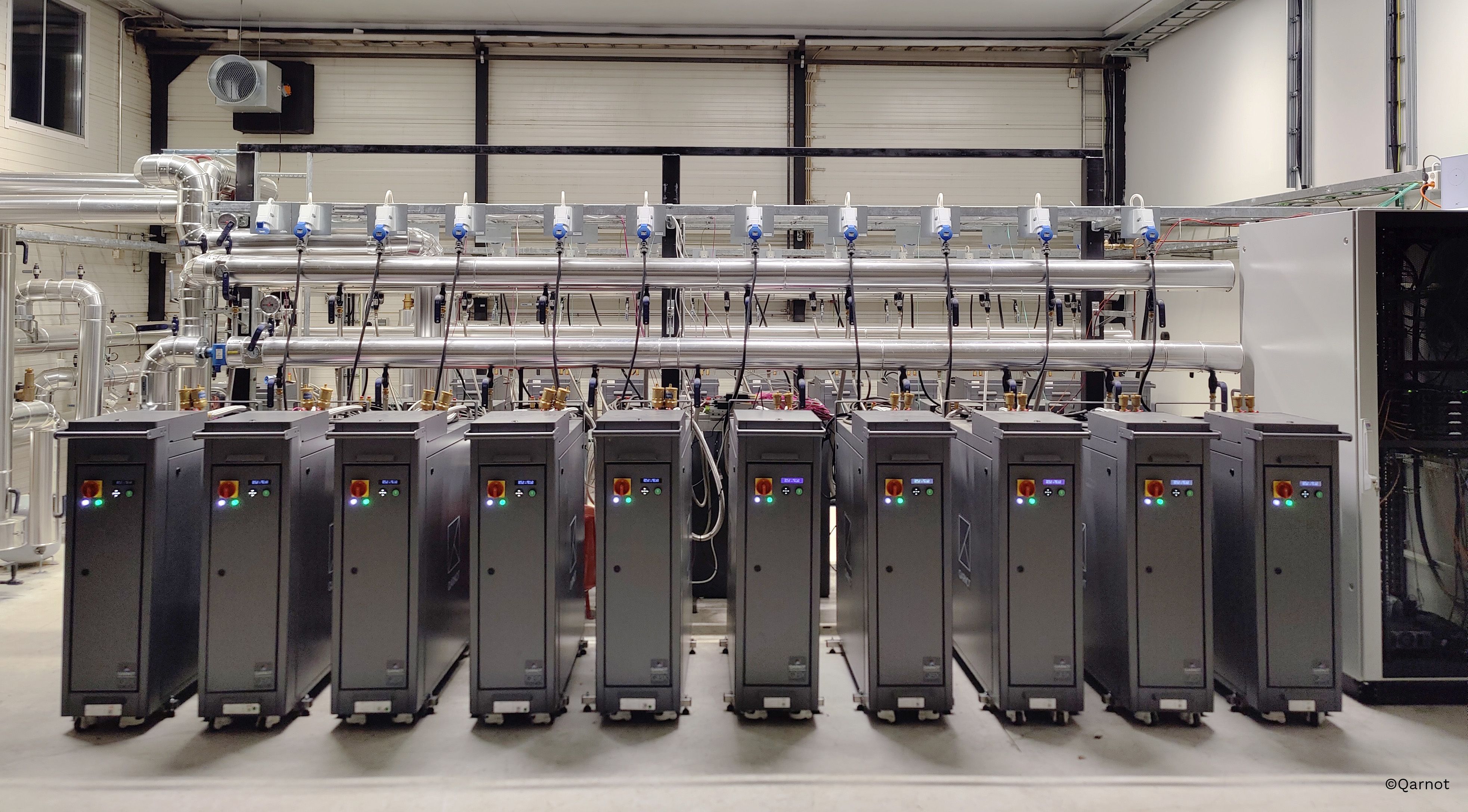
Computer processors, when in operation, can reach very high temperatures, up to 70 to 90°C at full load. To manage this heat, data centers use various cooling systems such as fans, air conditioners, and sometimes liquid cooling systems. These solutions, while effective in keeping processors at an optimal temperature, also consume a lot of energy. At Qarnot, we combine an energy source for two purposes: computing and heating. We integrate computer servers directly into patented digital boilers (we started with radiators) installed in high heat-consuming sites (pools, urban heat networks, industrial sites). Instead of simply dissipating the generated heat, we reuse it for heating. This optimizes energy efficiency and eliminates the need for cooling systems.
4. How do you proceed?
We are primarily computer scientists, and our core business is to distribute computer calculations according to the heat requirements of each of our sites, across Europe. The computer calculations of our clients (risk analysis, 3D rendering, fluid simulations, artificial intelligence, etc.) pass through fiber and are performed in boilers that incorporate our computer servers as heat sources, to heat both a pool in Finland and a heat network in the Ile-de-France region.
5. An essential resource, water. Warm water, a comfort element if there ever was one... What are the main advantages of the digital boiler?
The digital boiler incorporates computer processors placed closest to aluminum plates that are in direct contact with copper pipes carrying water. It heats water up to 65°C for pools, heat networks, or industries. It valorizes 95% of the heat generated by the computer servers and reduces our cloud clients' carbon footprint by 80%.
6. Staying on the water theme, how are pools heated?
Our digital boilers meet the constant heat requirement (also known as the heating base load) of pools. For example, we supply (in a closed loop) a pool in the city of Kankaanpää, Finland. Our boilers produce 140MWh per year, which represents 100% of the pool's needs during the summer season and an average of 60% of annual needs.
7. To what extent does this contribute to the energy transition of buildings?
The digital boilers recover the heat produced by computer servers, which would otherwise be dissipated by cooling systems, making them a renewable and recovery energy source (ENR&R), benefiting from a System V Title attesting to its ecological nature.
8. Regarding real estate, how do your previous achievements in professional buildings, especially radiators, differ from other contemporary green architectural projects?
We believe that the best energy is, above all, the one we do not consume. Sharing an energy source for two purposes is a significant advantage!
The advantage of digital radiators is that they meet a strong demand from developers, social landlords, or communities and can be installed closest to the heat requirement. However, they are subject to seasonality constraints, which is why we now only market boilers, still for professionals. Boilers, unlike other ENR&R systems, can be installed anywhere and ensure constant production without constraints related to location, climate, or deployment space.
9. What will be your next challenge in digital ecology?
Every day we discover new applications requiring hot water at temperatures above 55°C, whether for specific industrial processes or large heating systems. At the same time, the need for computing power continues to grow, opening up many opportunities.
Furthermore, we have begun R&D to develop innovative cold production systems from the recovery of waste heat.